
Here's a number most course creators don't want to hear: the average online course completion rate is between 5% and 15%.
That means for every 100 students who sign up, 85 to 95 of them will never finish what they started. They'll watch a few lessons, maybe download a resource or two, and quietly disappear.
This isn't just a vanity metric. Low completion rates hurt your business in tangible ways: fewer testimonials, higher refund requests, weaker word-of-mouth, and lower lifetime customer value.
The good news? Completion isn't about luck. It's about design. The courses that get students to the finish line share specific characteristics, and none of them require you to create more content.
In this guide, we'll break down the real data behind course completion, explain why most courses fail, and show you eight proven strategies to fix it.
The Real Numbers: Online Course Completion Statistics
Let's start with what the data actually shows.
Completion rates by platform type:
| Platform Type | Average Completion Rate | Notes |
|---|---|---|
| MOOC platforms (Coursera, edX, Udemy) | 3% – 6% | Free/low-cost, massive enrollment, minimal accountability |
| Mid-tier course platforms (Teachable, Thinkific) | 10% – 20% | Paid courses with some structure, limited engagement tools |
| Premium/cohort courses | 60% – 85% | High-ticket, structured timelines, live interaction |
| Corporate training (LMS) | 20% – 30% | Mandatory completion often inflates numbers |
Why the range is so wide:
Completion rates vary dramatically based on three factors:
- Price: Free courses have the lowest completion rates (under 5%). When there's no financial commitment, there's no urgency. Paid courses see 2-5x higher completion.
- Format: Self-paced, all-at-once courses have the lowest rates. Cohort-based, drip-delivered, or deadline-driven courses see significantly higher completion.
- Engagement design: Courses with community, progress tracking, and accountability mechanisms outperform content-only courses by a wide margin.
The takeaway: completion is a design problem, not a content problem. Most creators respond to low completion by adding more content. That usually makes things worse.
Why Low Completion Rates Actually Hurt Your Business
Some course creators shrug off low completion. "At least they bought it," they think. But here's what low completion actually costs you:
1. Fewer testimonials and success stories
Students who don't finish your course can't become success stories. And success stories are the most powerful marketing asset you have. Completion creates proof. Proof creates sales.
2. Higher refund rates
Students who drop off early are far more likely to request refunds, especially if they feel they "didn't get value." Even if your content is excellent, value is measured by outcomes, and outcomes require completion.
3. Weaker word-of-mouth
Completed students recommend courses. Dropout students don't. Every student who quits is a referral that never happens.
4. Lower lifetime value
Students who don't finish Course A will never buy Course B. Low completion kills upsell potential, repeat purchases, and long-term revenue.
5. Reputation erosion
If your course has a reputation for low completion (and students talk), it becomes harder to sell, regardless of the quality of your content. People buy transformation, not information. If no one's being transformed, the market notices.
The bottom line:
A course with 200 students and 60% completion will outperform a course with 1,000 students and 5% completion: in revenue, reputation, and growth. Retention is the new growth.
Why Students Don't Finish Online Courses
Understanding why students drop off is the first step to fixing it. Research consistently points to the same root causes:
1. Overwhelm
Courses that dump 40+ hours of content on students from day one create paralysis. Students don't know where to start, feel behind before they begin, and eventually give up. Less upfront content with clear sequencing outperforms content libraries.
2. No clear path or progress
Without visible milestones and a clear "you are here" indicator, students lose their sense of direction. They don't know how far they've come, how much is left, or what "done" looks like. Progress tracking isn't a nice-to-have. It's essential.
3. Isolation
Learning alone is hard. When students hit a roadblock and have no one to ask, no community to lean on, and no encouragement to keep going, they quietly quit. Community transforms solo learners into supported participants.
4. Lack of accountability
Self-paced courses with no deadlines, no check-ins, and no structure give students every reason to procrastinate. "I'll do it later" becomes "I forgot about it" within weeks.
5. Poor course design
Long, lecture-heavy modules with no interaction, no variety, and no application moments bore students. If your course feels like a Netflix binge of talking-head videos, engagement will drop fast.
6. Wrong audience
Sometimes the problem starts before enrollment. If your marketing attracts students who aren't genuinely committed to the outcome, like bargain hunters, casual browsers, or people with mismatched expectations, completion will suffer regardless of course quality.
7. Life happens
This one's real. Jobs, family, health: life interrupts. The courses that handle this best make it easy for students to pause and resume without losing progress or feeling like they've failed.
8. No immediate value
If students don't experience a "quick win" in the first lesson or two, engagement plummets. The first 48 hours after enrollment determine whether a student finishes the course, or forgets about it.
8 Proven Strategies to Increase Course Completion Rates
Here's the playbook. These strategies are based on what the highest-performing course creators do differently.
1. Design Journeys, Not Content Libraries
Stop thinking about courses as a collection of modules. Start thinking about them as guided journeys toward a specific outcome.
Every lesson should have:
- A clear learning objective (what will the student be able to do after this lesson?)
- A logical connection to what comes before and after
- A manageable scope (15-20 minutes max per lesson)
Structure your course around milestones, not modules. "By the end of Week 2, you'll have your first landing page live" is more motivating than "Module 3: Landing Pages."
2. Use Drip Content to Prevent Overwhelm
Instead of opening everything at once, release content on a schedule. This:
- Prevents overwhelm
- Creates anticipation
- Gives students time to apply what they've learned before moving on
- Mimics the structure of in-person classes (which have much higher completion)
A weekly drip with daily micro-lessons is a proven format. Platforms like CustomerHub make drip delivery easy to configure and fully automated.
Recommended Reading: Best Drip Course Software Tools
3. Build In Progress Tracking
Visual progress indicators are surprisingly powerful. When students can see they're 40% done, they're motivated to keep going. When there's no progress indicator, it's easy to lose momentum.
Effective progress tracking includes:
- Lesson completion checkmarks
- Module progress bars
- Overall course completion percentage
- "Next step" prompts that guide students forward
CustomerHub includes built-in progress tracking that shows students exactly where they are in their journey.
4. Create a Community Around Your Course
Community is the single most effective lever for increasing completion. Students who participate in a community are 5x more likely to finish a course than solo learners.
Community drives completion through:
- Social accountability: seeing peers make progress creates positive pressure
- Peer support: students help each other through roadblocks
- Encouragement: a simple "keep going!" from a fellow student or the instructor matters
- Belonging: people don't quit communities they feel part of
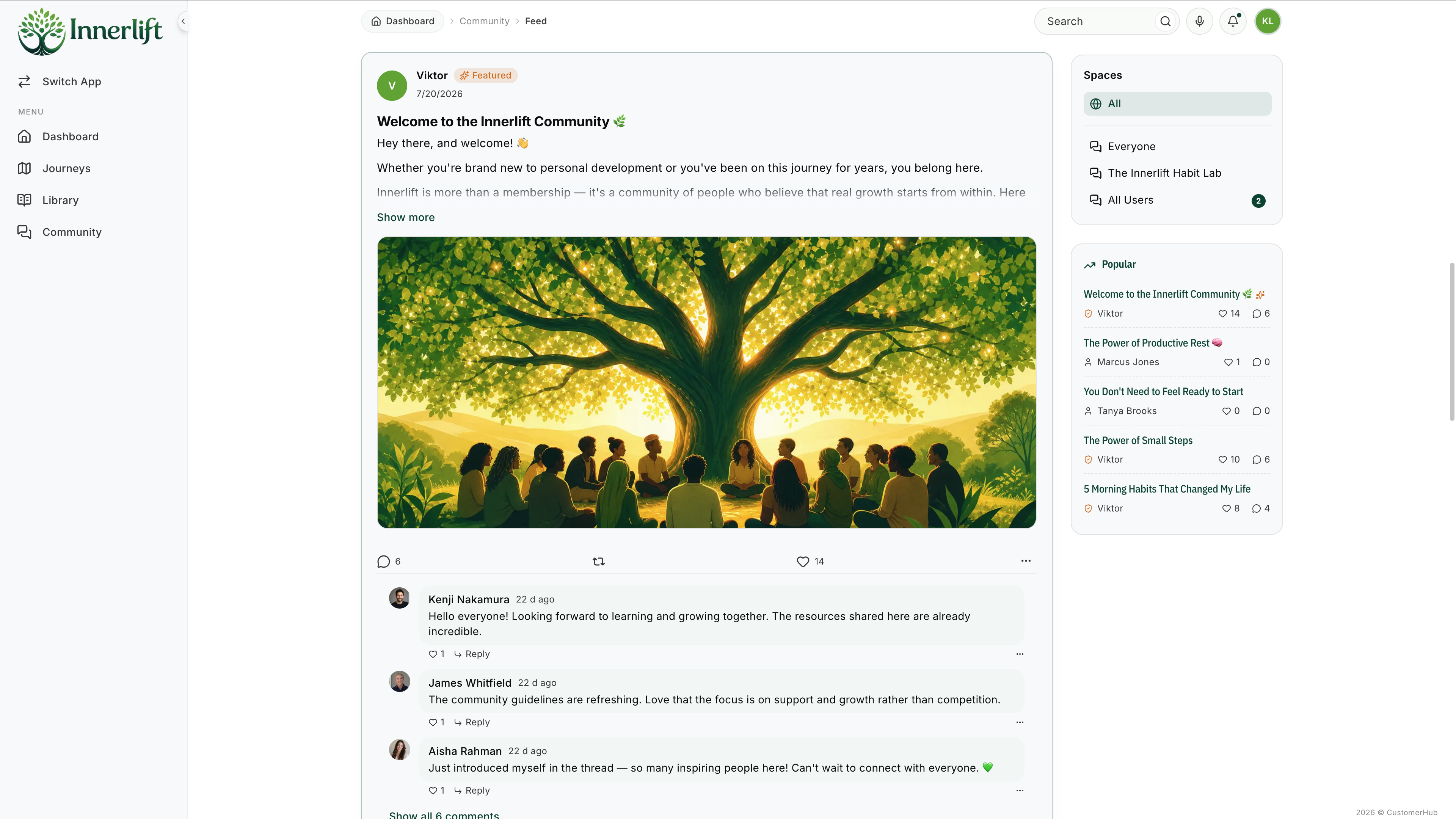
With CustomerHub, community is built into the learning experience, not bolted on as a separate tool. Discussion feeds, Q&A, and engagement happen right alongside the course content.
5. Front-Load Quick Wins
The first 48 hours after enrollment are critical. If a student doesn't engage meaningfully within the first day or two, the chances of them completing the course drop dramatically.
Design your first lesson (or onboarding sequence) to deliver an immediate, tangible result:
- A completed worksheet they can use right away
- A strategy they can implement today
- A mindset shift that makes the rest of the course feel essential
This "first win" creates momentum that carries students through the harder parts of the course.
Recommended Reading: 5 Tactics to Create a More Engaging Course
6. Send Strategic Nudges and Reminders
Students who fall behind don't need more content. They need a nudge. Automated email or in-app reminders at key moments can dramatically reduce dropout:
- Welcome sequence: Onboard new students with clear next steps within minutes of enrollment
- Inactivity nudges: "It's been 5 days since your last lesson. Ready to jump back in?"
- Milestone celebrations: "You just completed Module 2! Here's what's next."
- Completion encouragement: "You're 80% done! Finish strong."
These messages should be warm, encouraging, and focused on the student's progress, not pushy or guilt-inducing.
7. Keep Lessons Short and Action-Oriented
Attention spans are short. The sweet spot for individual lessons is 10-20 minutes, with a clear action item at the end of each one.
Instead of a single 60-minute lecture, break it into:
- A 10-minute video explaining the concept
- A 5-minute walkthrough or demonstration
- A 5-minute exercise or reflection prompt
Every lesson should end with something to do, not just something to watch. Application cements learning and creates the feeling of progress.
8. Invest in Onboarding
The gap between "I just bought this course" and "I'm actively learning" is where most students are lost. A structured onboarding experience closes that gap.
Effective course onboarding includes:
- A welcome message or video setting expectations
- Clear instructions on how to navigate the platform
- A suggested schedule or study plan
- Introduction to the community (if applicable)
- The first "quick win" lesson
Platforms like CustomerHub support structured onboarding flows that guide new students from purchase to first lesson, automatically.
Recommended Reading: Online Course Design Best Practices
What High-Completion Courses Have in Common
After analyzing hundreds of courses, a clear pattern emerges. Courses with completion rates above 50% share these traits:
✅ Clear, specific outcome: "Build your first sales funnel in 14 days" beats "Learn marketing"
✅ Structured timeline: Weekly or daily schedule with deadlines
✅ Short, focused lessons: 10-20 minutes each with action items
✅ Drip delivery: Content released progressively, not all at once
✅ Built-in community: Discussion, Q&A, and peer interaction
✅ Progress visibility: Students always know where they stand
✅ Strong onboarding: First lesson delivers an immediate win
✅ Strategic nudges: Automated reminders at key drop-off points
Notice what's not on the list: more content, fancier production, or longer videos. Completion is about design and engagement, not volume.
How CustomerHub Helps You Build Courses Students Actually Finish
Most course platforms give you a place to host content. CustomerHub gives you a system designed for student outcomes.
Here's how CustomerHub supports higher completion rates:
- Drip content delivery: Release lessons on a schedule that prevents overwhelm and keeps students on track
- Built-in progress tracking: Students see exactly where they are in their journey, creating momentum to continue
- Integrated community: Discussion, Q&A, and peer interaction happen right alongside lessons, not in a separate app
- Structured onboarding: Guide new students from purchase to first lesson with automated welcome sequences
- Branded member portals: A clean, distraction-free learning environment focused on the content
- Engagement analytics: See which lessons have drop-off, which are most engaging, and where students get stuck
CustomerHub is built for coaches, creators, and educators who understand that the real value isn't in selling a course. It's in delivering a transformation.
10,000+ portals created. 10M+ members served. $100M+ in creator revenue.
Start your 30-day free trial today →
FAQs About Online Course Completion Rates
What is the average online course completion rate?
The average completion rate across all online courses is between 5% and 15%. Free MOOC platforms see rates as low as 3-6%, while premium cohort-based courses can achieve 60-85%.
Why are online course completion rates so low?
The most common reasons are overwhelm (too much content at once), lack of accountability, no community or support, poor course design, and no visible progress tracking. Most low-completion courses have a content problem masquerading as a design problem.
How do I calculate my course completion rate?
Divide the number of students who completed the course by the total number of students enrolled, then multiply by 100. For example, if 30 out of 200 students finished, your completion rate is 15%.
What is a good course completion rate?
For self-paced online courses, 30-40% is above average. For cohort-based or structured courses, 60%+ is achievable. If your rate is below 15%, there's significant room for improvement through design changes.
Does price affect course completion?
Yes. Free courses have the lowest completion rates (under 5%), while paid courses see 2-5x higher completion. When students invest financially, they're more committed to seeing a return on that investment.
How does drip content improve completion rates?
Drip content releases lessons on a schedule instead of all at once. This prevents overwhelm, creates anticipation, gives students time to apply what they've learned, and mimics the structure of in-person classes, which have much higher completion rates.
What role does community play in course completion?
Community is the single most effective lever for completion. Students in communities are roughly 5x more likely to finish than solo learners. Social accountability, peer support, and a sense of belonging all reduce dropout.