Kajabi and Skool take opposite approaches to building an online business. Here's how to decide between them, and why some creators are choosing a third path.
The Quick Verdict
Kajabi and Skool are both popular, but they solve fundamentally different problems.
Here's the simplest way to think about it:
- Kajabi is a business-in-a-box. It wants to handle your courses, email, funnels, website, and community under one roof.
- Skool is a community-in-a-box. It wants to create a space where your members interact, engage, and learn together.
Neither is "better." They're built for different business models. Kajabi is for creators who lead with marketing. Skool is for creators who lead with community.
| Kajabi | Skool | CustomerHub | |
|---|---|---|---|
| Best for | All-in-one course business | Community-led learning | Post-sale delivery, onboarding & retention |
| Starting price | $71/mo (annual) | $7.50/mo (annual) | $40/mo (annual) |
| Free trial | 14 days | 14 days | 30 days |
| Courses | ✅ Advanced | ✅ Basic | ✅ Structured paths |
| Community | ✅ Added feature | ✅ Core product | ✅ Integrated with delivery |
| Website builder | ✅ Built-in | ❌ | ❌ (plugs into your existing site) |
| Email marketing | ✅ Built-in | ❌ | ❌ (works with your existing email tool) |
| Sales funnels | ✅ Built-in | ❌ | ❌ (not a marketing tool) |
| Gamification | ❌ | ✅ Leaderboards & levels | ❌ |
| Client portal | ❌ | ❌ | ✅ Branded portals |
| Onboarding flows | ❌ | ❌ | ✅ Built-in |
| Live calls | ❌ Requires Zoom | ✅ Built-in | ❌ Requires Zoom/Meet |
| Integrations approach | Wants to replace your stack | Zapier only (Pro plan) | Full REST API + webhooks, plus native connectors |
| Philosophy | All-in-one | Community-first | Post-sale focused |
Head-to-Head Breakdown
1. Community Features
Skool was built around community from day one, and it shows. You get a Facebook-group-style feed with categories, pinned posts, polls, and threaded comments. Members earn points when others like their content, climb a leaderboard, and level up. You can gate courses behind levels, which creates a natural incentive loop: participate more, unlock more. The gamification isn't a gimmick. For the right audience, it drives real daily engagement.
Skool also includes built-in live calls. No Zoom link needed. Members can join directly from the platform, and you can go live anytime or schedule events through the built-in calendar. Worth noting: live call features are more limited on the Hobby plan, and there's no built-in recording library, so if you rely heavily on call replays, you'll need a workaround.
Kajabi added community features later, and they work fine. Topic-based spaces, threaded discussions, activity feeds, all tied to your products. But the community experience feels like a feature within a larger platform, not the main event. There's no gamification, no leaderboard, and no native live calls.
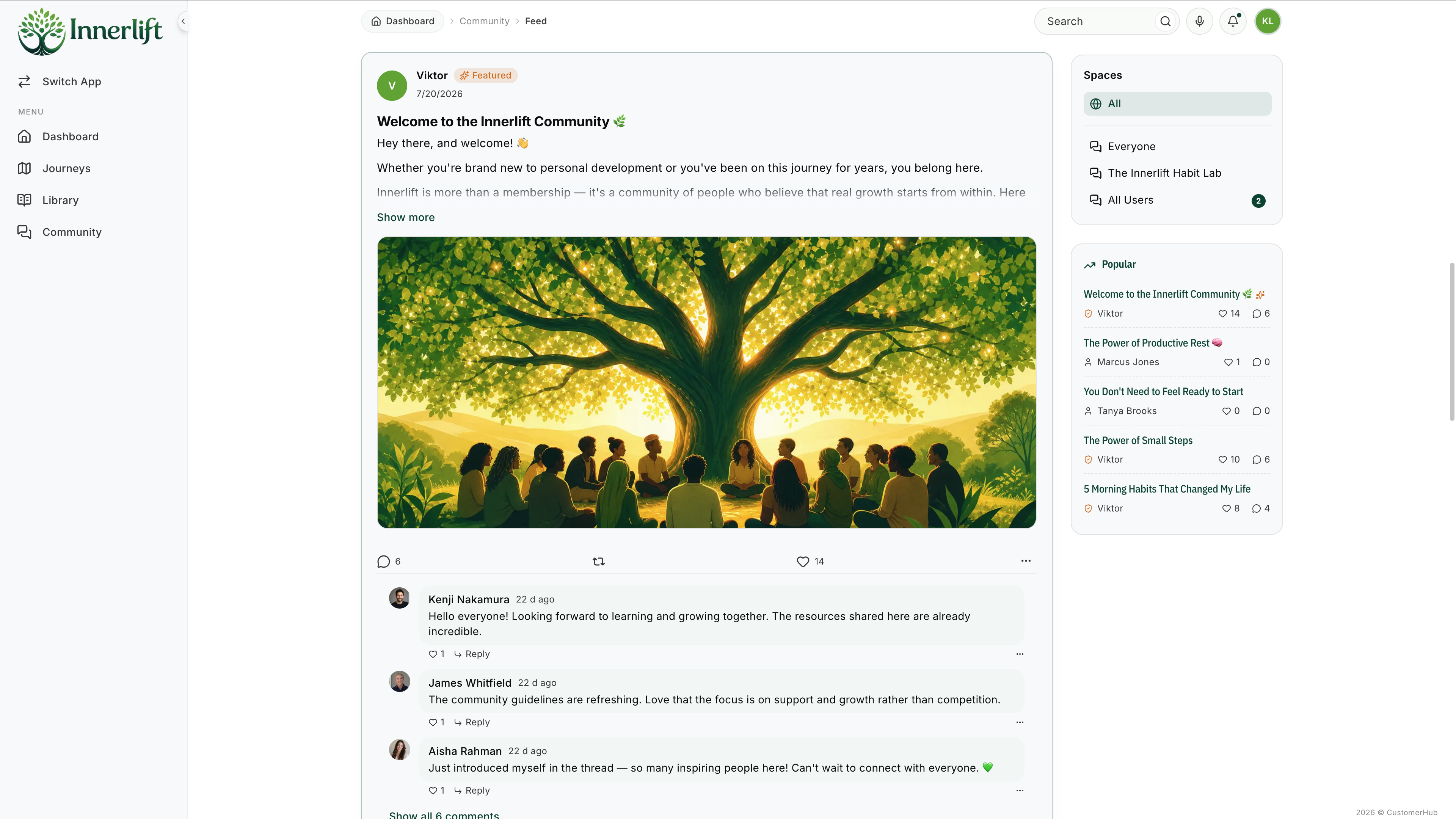
CustomerHub integrates community directly into the member experience. Private feeds, discussion, Q&A, and events live alongside courses and onboarding flows in one branded portal. Members don't jump between "the community" and "the course." It's all one experience. But here's the thing: engagement alone doesn't drive retention. Structured learning paths, onboarding flows, and meaningful progress tracking do. CustomerHub doesn't try to compete on gamification or social features. It's built to make sure members actually complete what they started.
Winner: Skool for pure community engagement, gamification, and native live calls. If daily member interaction is your primary business model, Skool is purpose-built for it.
2. Course Creation & Delivery
Kajabi offers a robust course builder with multimedia lessons, drip content, assessments, and certificates. You can build structured courses with modules, quizzes, and completion tracking. It's not the most flexible builder on the market, but it covers most use cases well.
Skool keeps course creation deliberately simple. You create a "classroom" with modules and lessons, add video (native hosting or embed from YouTube/Vimeo/Loom), and that's about it. No quizzes, no certificates, no automatic progression. Students manually mark lessons as complete. If your course content is straightforward (video lessons plus supporting materials), Skool handles it. If you need a structured learning experience with assessments and tracked outcomes, it falls short.
CustomerHub approaches content delivery differently. Instead of a traditional course builder, it delivers content through branded portals with structured learning paths, digital products, file libraries, and resource hubs. The focus isn't on building a course; it's on guiding someone through a transformation. Progress tracking, completion data, and clear next steps keep members moving forward.
Winner: Kajabi for full-featured course building. CustomerHub for structured delivery with outcomes tracking. Skool if you just need simple video lessons inside a community.
3. Marketing & Sales
Kajabi dominates here. Built-in email marketing with sequences and broadcasts, landing pages, sales funnels, pipeline automations, and checkout pages. If you're starting from scratch and want one platform to handle your entire sales engine, Kajabi does it all. No third-party tools needed.
Skool has no marketing features. No email, no funnels, no landing pages. Your marketing happens elsewhere. Skool handles payment processing with its own built-in processor (2.9% transaction fee on Pro, 10% on Hobby), but there are no upsell flows, abandoned cart sequences, or sales automation. You bring the traffic; Skool gives them a place to land.
CustomerHub doesn't do marketing either, and that's by design. Instead of replacing your marketing stack, it plugs into it. Already using ActiveCampaign for email? Keep it. Running funnels through HighLevel? Keep those too. Selling through Stripe? CustomerHub connects natively. The philosophy: you've already built a marketing engine that works. Why rip it out?
Winner: Kajabi for built-in marketing. But the question is whether you want your community platform to be your marketing platform too. If you already have tools you love, Kajabi means paying for features you won't use.
4. Client Onboarding
Kajabi doesn't have dedicated onboarding features. You can create a drip-content sequence or an automation to simulate one, but there's no structured onboarding flow builder.
Skool doesn't have onboarding either. New members land in the community feed and figure things out from there. You can pin a welcome post or create a "Start Here" course module, but there's no guided path from signup to activation. For self-directed communities this is fine. For programs where clients need structured guidance, it's a gap.
CustomerHub was built for this. Structured onboarding flows, clear next steps, automated access, and progress tracking. If your business involves getting clients up to speed quickly (coaching programs, consulting engagements, agency onboarding), CustomerHub handles it natively.
Winner: CustomerHub. Not close.
5. Pricing & Value
Kajabi:
- Starter: $71/mo (annual) or $89/mo monthly. 1 product, 1 pipeline, 250 contacts
- Basic: $143/mo (annual) or $179/mo monthly. 3 products, 3 pipelines, 10,000 contacts
- Growth: $199/mo (annual) or $249/mo monthly. 15 products, 15 pipelines, 25,000 contacts
- Pro: $399/mo (annual) or $499/mo monthly. 100 products, 100 pipelines, 100,000 contacts
Kajabi is the most expensive option. You're paying for the all-in-one stack. If you'd otherwise need separate tools for email, funnels, website, and courses, the math can work out. But if you already have tools you like, you're paying for features sitting idle.
Skool:
- Hobby: $7.50/mo (annual) or $9/mo monthly. Unlimited members, courses, videos, live calls. 10% transaction fee. No custom domain, no affiliates
- Pro: $82/mo (annual) or $99/mo monthly. Everything in Hobby plus 2.9% transaction fee, custom domain, affiliates, Zapier integration
Skool is remarkably affordable. Two plans, simple pricing. The catch: the Hobby plan's 10% transaction fee adds up fast. If you're doing $1,000+/month in revenue, the Pro plan pays for itself immediately. Note that each Skool subscription covers one community. If you want multiple communities, you pay per community.
CustomerHub:
- Onboard: $40/mo (annual). Onboarding flows, filebox, digital products, community
- Educate: $65/mo (annual). Full course delivery + everything in Onboard
- Engage: $107/mo (annual). Full community features + everything in Educate
CustomerHub sits in between. More affordable than Kajabi, slightly more than Skool Pro. No contact limits, no product caps, no transaction fees. You're paying for capabilities, not scale penalties.
Winner: Skool on raw price. CustomerHub for value with zero transaction fees. Kajabi if you need everything included and don't mind paying for it.
6. Ease of Use
Kajabi is polished but complex. Courses, funnels, emails, communities, automations, website. The learning curve is real. Expect to spend weeks getting comfortable. Kajabi University helps, but "all-in-one" also means "a lot to learn."
Skool is dead simple. You can have a community with courses live in under an hour. The interface is clean and opinionated. There aren't many settings because there aren't many options. For creators who want to stop fiddling with tech and start engaging with members, Skool removes friction better than almost anything.
CustomerHub is designed for fast setup too. Launch in minutes, not weeks. Templates, drag-and-drop, no coding. The scope is intentionally narrower (post-sale only), which keeps the experience clean and focused.
Winner: Skool for absolute simplicity. CustomerHub is close behind. Kajabi requires the most investment upfront.
7. Integrations & Flexibility
Kajabi wants to be your entire stack. It integrates with Stripe and PayPal for payments, plus Zapier for external connections. But the philosophy is "use Kajabi for everything." If you love your current email tool or funnel builder, Kajabi doesn't make it easy to keep them.
Skool is limited. Zapier integration is only available on the Pro plan ($82/mo annual). The Zapier connection supports four triggers/actions: send paid member info to your CRM, send membership questions to your CRM, invite a member to your group, and unlock a course for a member. No native API beyond that.
CustomerHub connects natively to Stripe, Zapier, Keap/Infusionsoft, HighLevel, and ActiveCampaign. Beyond that, the CustomerHub Web API provides a full REST API with 20+ endpoint groups and real-time webhooks, so you can sync data with external systems or build a fully custom front-end.
Winner: CustomerHub. Native integrations for the common tools, plus a full API for anything custom. Skool's integrations are minimal.
8. Content & Digital Product Delivery
Kajabi handles courses, coaching, podcasts, and digital downloads. Products are tied to offers, which connect to your marketing funnels. Strong for knowledge entrepreneurs selling multiple product types.
Skool is focused on courses and community. There's no dedicated digital product delivery, no file libraries, no resource portals. If you sell templates, toolkits, PDFs, or resource libraries alongside your community, you'll need another tool for delivery.
CustomerHub is built specifically for content delivery. Courses, digital products, file libraries, resource portals, all in a branded, distraction-free environment. The Filebox feature lets you deliver any type of digital content. If you sell more than just courses, CustomerHub handles the full range cleanly.
Winner: CustomerHub for diverse digital product delivery. Kajabi for multimedia versatility. Skool for courses-within-community only.
The Gap Neither Fills
Here's what most comparison articles won't tell you: Kajabi is built around selling. Skool is built around engaging. But what happens between the sale and the engagement?
That's the gap.
- Members sign up and never log in
- Course completion rates sit below 15%
- Clients churn because they never got properly onboarded
- There's no structured path from "I just bought this" to "I'm getting real results"
Kajabi can sell the course. Skool can create a buzzing community. But neither provides structured onboarding, guided delivery, or the post-sale experience that turns a buyer into a successful client.
This is the gap CustomerHub was designed to fill. It doesn't replace your marketing or your community. It fills the space between the sale and the outcome. Your marketing stack stays intact. Your community stays intact. CustomerHub adds the missing delivery layer where onboarding, content, and progress tracking come together in one cohesive, branded experience, so your customers actually complete, connect, and succeed.
Kajabi helps you sell. Skool helps you engage. CustomerHub helps them finish.
Who Should Choose What
Choose Kajabi if:
- You're starting from scratch and want everything in one place
- Marketing and funnels are your priority
- You don't have (or don't want) a separate email tool, website, or funnel builder
- You're willing to pay a premium for convenience
- Your business model is primarily selling courses and digital products
Choose Skool if:
- Community engagement is the core of your business
- You want dead-simple setup with minimal tech overhead
- Gamification and daily member interaction matter to your model
- You're comfortable with basic course features
- You want the most affordable starting point
- You don't need deep integrations or onboarding flows
Choose CustomerHub if:
- You already have a way to sell (website, email, funnels in place)
- Your bottleneck is after the sale: onboarding, delivery, engagement
- You're a coach, consultant, or program creator who needs client portals
- You want a branded, distraction-free experience for your members
- Completion rates, retention, and client success matter more than social engagement or marketing
- You want to keep your existing stack and add a purpose-built delivery layer
- You need real API access and deep integrations
FAQ
Is Skool worth it in 2026?
If your business model is community-led (group coaching, masterminds, cohort-based learning), Skool is excellent value at $82/mo (annual). The gamification drives real engagement, and the simplicity means you spend time with members instead of configuring software. But if you need structured courses, onboarding, or deep integrations, you'll outgrow it.
Can I use Skool and Kajabi together?
Technically yes, but it creates a fragmented experience. Your members would log into Kajabi for courses and Skool for community. Some creators do this, but it adds friction and confusion. A better approach: look for a platform that unifies the experience. CustomerHub can handle delivery, onboarding, and community in one branded portal while your existing marketing tools handle the rest.
What's cheaper than Kajabi?
Both Skool and CustomerHub are significantly cheaper. Skool starts at $7.50/mo annual (with 10% transaction fees) or $82/mo annual for Pro. CustomerHub starts at $40/mo annual with no transaction fees. Kajabi's cheapest plan is $71/mo annual and limits you to 1 product and 250 contacts.
Does Skool have email marketing?
No. Skool has no email marketing, no landing pages, no funnels. You'll need external tools for all of that. Many Skool creators pair it with ConvertKit, ActiveCampaign, or HighLevel for email and marketing.
Does Skool work for 1:1 coaching?
Skool is designed for group experiences, not 1:1 coaching delivery. There's no client portal, private resource area, or individual progress tracking. If your business is primarily 1:1 (consulting, coaching, agency work), a dedicated client delivery tool like CustomerHub is a better fit. It gives each client their own branded portal with personalized onboarding, content, and progress tracking.
Can I switch from Skool to Kajabi (or vice versa)?
Switching is possible but disruptive. Course content doesn't transfer automatically, community history is lost, and member data needs manual migration. Think carefully about your long-term needs before committing.
Can I use CustomerHub alongside Skool or Kajabi?
Yes. Some creators use Kajabi or Skool for marketing and community but use CustomerHub as the delivery portal for a cleaner client experience. CustomerHub integrates via Stripe and Zapier, so it works alongside other tools without conflict.
Can developers build custom integrations with CustomerHub?
Yes. CustomerHub's Web API provides full programmatic access to pages, products, onboarding, community, completions, analytics, and more (20+ endpoint groups in total). You can sync data with external systems, trigger webhooks on real-time events, or build a fully custom front-end using CustomerHub as the back-end.
Bottom Line
Kajabi and Skool are both strong platforms, built for different creators. Kajabi is the Swiss Army knife for course businesses. Skool is the engagement engine for community builders. But if your real challenge isn't "How do I sell more courses?" or "How do I get more engagement?" and instead is "How do I make sure the people who buy actually succeed?" ... that's a different problem that needs a different tool.
CustomerHub is that tool. One hub for everything after the sale.
Ready to see the difference? Start your free 30-day trial of CustomerHub. No credit card required.