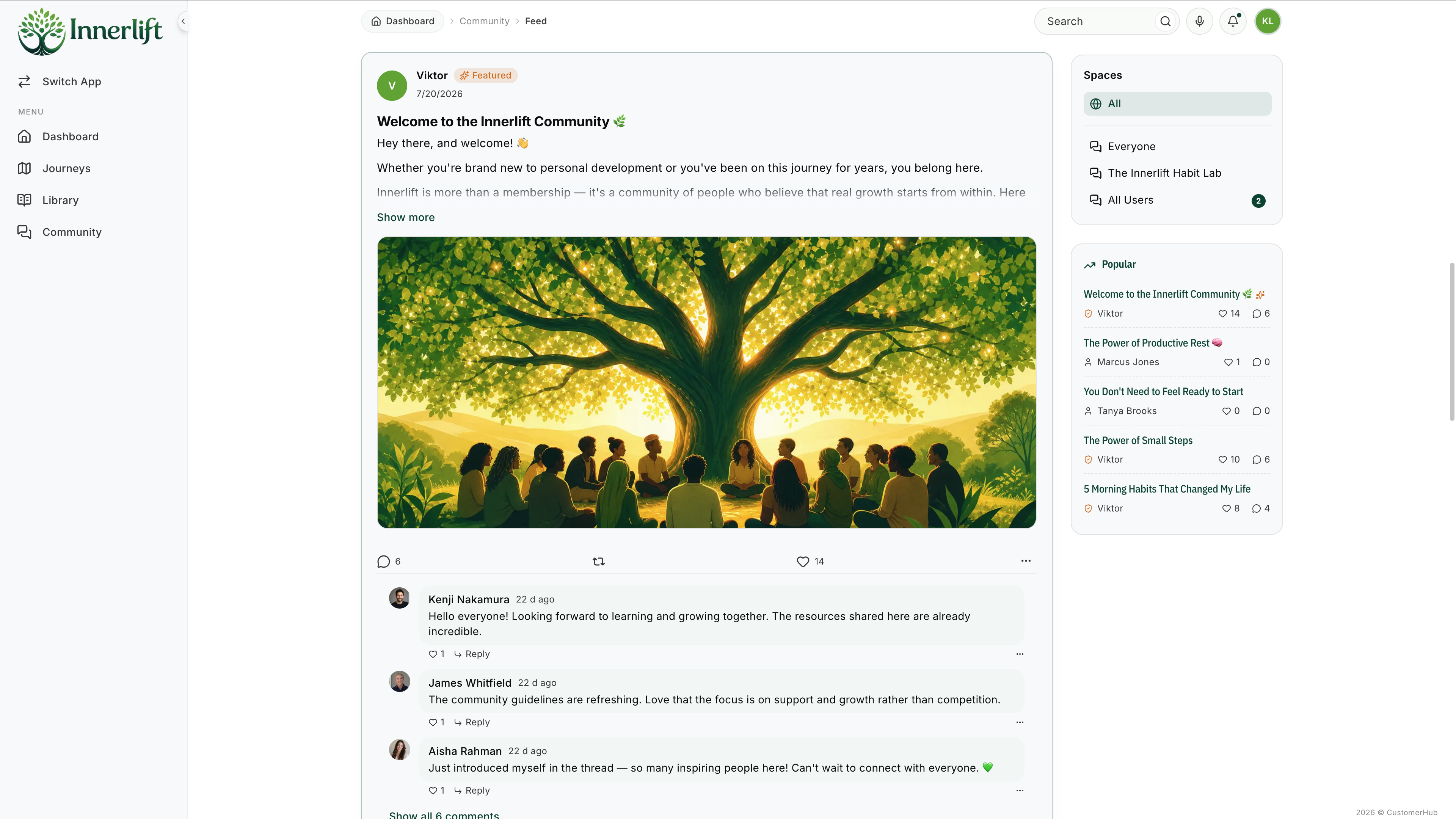

If you are looking to sell digital products in 2025, the focus should be on what matters. Making digital products is one of creators' main sources of income. Yet, a lack of technical skills, the need for numerous tools, and non-continuous income are the most common problems among newbies. If you want to sell digital products with confidence, securely, and for the long term, this article will make it crystal clear what they really are in 2025 and how CustomerHub systems can solve the same issues that inhibit the progress of coaches, counsellors, and creators at large.
Discover CustomerHub Features
Why has the market for digital products grown so much?

The digital product industry generated revenue of over 331 billion USD by 2024, and experts predict it will grow further, reaching 662 billion USD by 2030.
- Tech is why over 47% of creators throw in the towel before their first product is launched.
- All in all, 61% of creators use 4-9 tools as a bundle.
- Creators suffer a 30–45% revenue loss due to poor product organization and low student engagement.
That is exactly where CustomerHub comes in—it has a unified, tidy system for all your courses, downloads, communities, and memberships, so selling digital products is less of a.
What digital products sell best in 2025?
Let's look at the formats that consistently sell and the structure that enhances conversions.
Create Your First Course

1. Are Online Courses Still the Best Way to Sell Digital Products?
Online courses are still the most profitable category.
More than 70% of customers prefer structured learning instead of scattered YouTube videos.
Strong-performing course types include:
- Beginner transformation courses
- Niche skill development
- Industry-specific certifications
- Short micro-courses (huge growth in 2025)
A fitness creator put a 4-week micro-course into CustomerHub and included progress tracking. The number of people who finished the course increased from 52% to 83%, so the creator had more people upgrading and referring.
2. Should You Sell Digital Templates or Toolkits?
Templates work very well for conversion because consumers mostly prefer them.
The most selling formats are:
- Canva templates
- Email sequences
- Notion dashboards
- Business SOP kits
Templates often have higher conversion rates (12–18%) compared to full courses because the value feels instant.
Attach templates in course modules or deliver them as standalone products; both are possible in CustomerHub.
3. Are Memberships the Best Long-Term Way to Sell Digital Products?
If your goal is a steady flow of revenue over time, the membership model will work best.
On average, the earnings of a creator who sells memberships are 2.4 times higher than those of a creator who sells products one by one.
- Expert Calls
- Content Every Month
- Accountability
The story of how a language coach gathered scattered content from WhatsApp into a single CustomerHub membership area. The result was a 29% decrease in churn and a 38% increase in monthly revenue over three months.
4. Are E-books Still Among the Best Digital Products to Sell?
E-books can be highly successful as long as they offer an immediate solution to a specific problem.
Types that have the highest sales are:
- “101 Ideas” books
- Niche guides
- Industry reports
- Starter manuals
- Learning frameworks
- offer pilot projects
- Give away freebies
- set up low-priced
CustomerHub is a platform that empowers publishers to incorporate a book with bonus videos or other resources, which can lead to a substantial increase in product assessment.
5. Can Coaching Programs Be Turned Into Digital Products to Sell?
Certainly, and coaching is among the creators' top 3 revenue drivers, given its increasing popularity and audience acceptance.
The possible options of services to package as digital products are:
- 1:1 coaching
- Group coaching
- Expert sessions
- Hybrid programs including videos + calls + worksheets
Your course follows a structured pathway in CustomerHub—an obvious way for your students to experience modules, milestones, and actions, reducing drop-offs.
What goals matter when creating digital products?
Let’s come up with a structured, easy procedure.
Step 1: What problem does your digital product solve?
Digital products that generate high profits for the owner are always associated with a very clear, specific problem that needs to be solved.
For instance:
- “Show me the best marketing strategies for my business” to entrepreneurs.
- “Build me a financial plan for my family” for financial advisors.
- “Guide me regarding different types of investments” to people who are planning to retire soon and have no experience with the stock market.
The more precise the problem the product is intended for, the higher the sales, since people showing interest in the overall educational content are two to three times as likely as those who are only interested in a certain aspect of the content.
Step 2: Who is your target buyer for digital products?
Every successful digital product should address:
- A specific person
- At a particular stage
- With a certain problem
CustomerHub’s membership analytics can help you keep track of what type of content/approaches this audience is engaging with the most, so that you can build offers that will convert better.
Step 3: What format is right for your audience?
Different customers prefer different formats.
Goal: Best Digital Product Format
- Teach a transformation – Online course
- Deliver quick wins – Templates/toolkits
- Build recurring revenue – Membership site
- Position as a premium – Coaching program
- Build authority – E-book + mini course
Creators who use CustomerHub can mix formats within a single product.
Step 4: How should you price digital products?
Follow this simple pricing framework:
FormatAverage Range
- E-books – $9–$39
- Templates – $17–$97
- Micro-courses – $27–$147
- Full Courses – $197–$997
- Memberships – $19–$99/month
- Coaching – $500–$5000+
Creators who are pricing intelligently (focus on the value derived from the purchase, not the format) are earning 34% more money than those who are pricing by hours or content size.
Step 5: How can you deliver digital products fast?
CustomerHub makes the biggest headache disappear.
The following things can be done with CustomerHub:
- Upload videos, templates, PDFs, or lessons
- Add progress tracking
- Organize modules and milestones
- Add community spaces
- Automate content release
- Personalize member dashboards
How can you earn consistently when you sell digital products?

1. Free vs paid content: what’s the difference?
Free content won't bring the instant income that paid content does, but it can be even more effective in the long run.
- An Instagram account with followers
- YouTube blog channel
- A Twitter page where you discuss trends and sales
- E-books
- Live webinar
When you continuously create content, you will soon notice a rise in your online product sales by almost 300% after three months.
2. Do emails still work for selling digital products?
Email marketing remains the most cost-effective channel for digital product marketers.
Here are the four steps to the simplest 4-email sales series:
- Introduce a problem that your audience faces
- Suggest a very fast and easy solution
- Give an example of a customer and how your product helped them.
Adding the CustomerHub client portal to your email campaign makes the purchasing process much easier for your customers.
3. What landing page converts best?
On a product conversion page, you should have:
- Main header
- Product or service guarantee
- Significant gains or success points
- Small training or item details
- Stories from buyers (at least 2)
- Product or service
4. How do bundles help you sell digital products?
The effect of bundles on your income could be as high as 30–60% directly.
- E-book + templates
- Course + coaching call
- Membership + starter toolkit
- Micro-course + worksheets
With CustomerHub, you can bundle products and provide customers with an integrated, unified experience while you sell.
Why is CustomerHub the fastest way to sell digital products?
- Customer complexity reduction (no separate systems for courses, communities, templates, or coaching)
- Students complete more lessons because CustomerHub’s design is neat and well-organized.
- 5–10 hours per week saved on tech management tasks
- Your customers enjoy a high-quality, distraction-free experience
If you are looking for a platform that lets you sell digital products without the complications, then CustomerHub could be a one-stop shop for you, with all the functionality neatly in one place—courses, downloads, communities, coaching, and memberships.
If you're dreaming of a more streamlined, systematized way to develop and expand the business of your digital products, look into CustomerHub and see how the creator workflow can turn out.