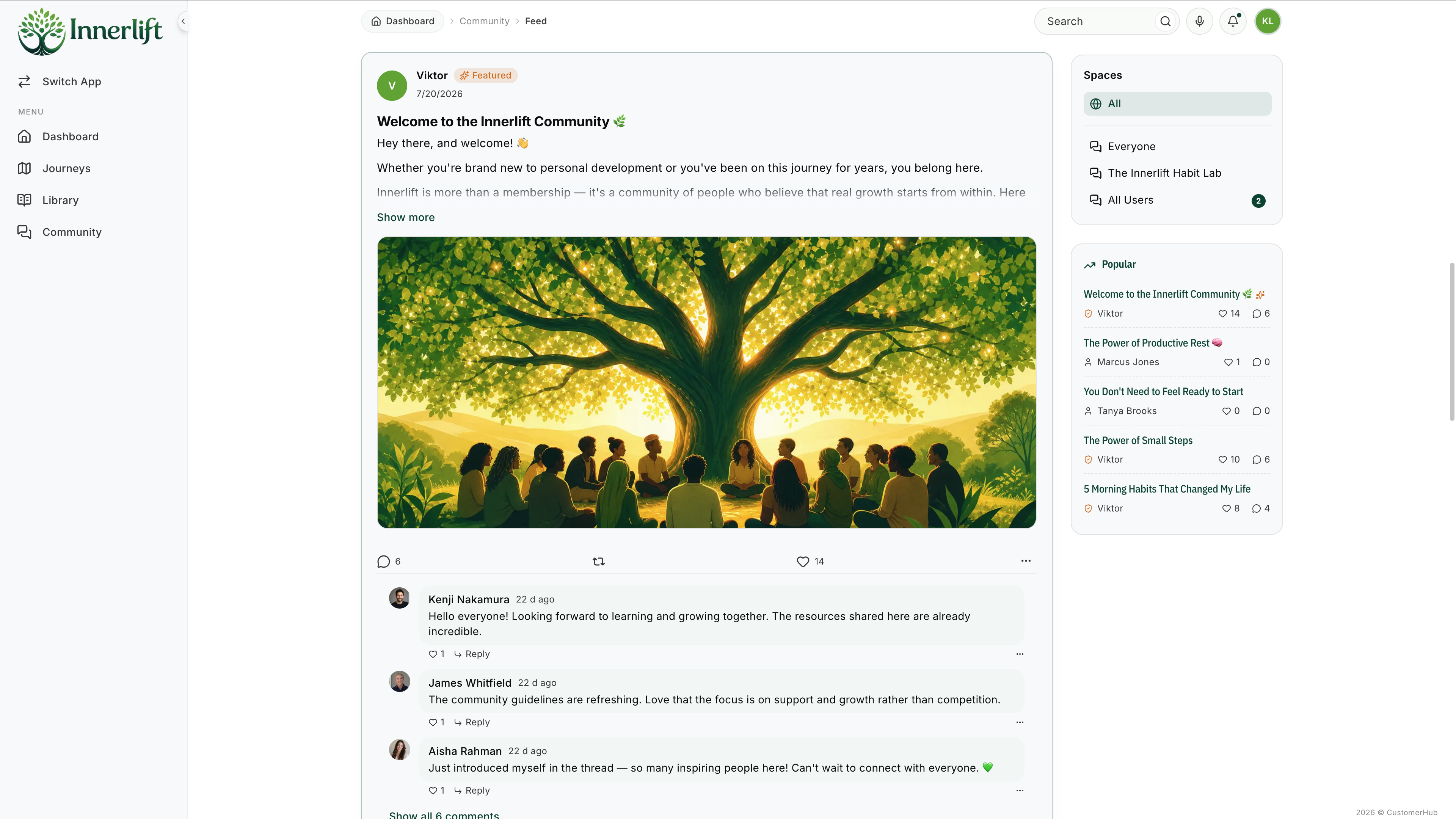


Have you been thinking about how to set up drip content for an online course? Most creators fight the same battle—students consume the first module and then disappear, and engagement drops very quickly. Drip delivery helps—if it’s implemented the right way. The following article shows how teachers and creators can schedule their content to increase completion rates, keep students interested, and do less work. At the same time, CustomerHub invisibly powers the experience in the background.
Why do learners stay longer with drip delivery?
Many online learning platforms have tracked the performance for years, and the trend is unmistakable: when everything is made available at once, up to 78% of students have already dropped out by Module 3. However, once course creators start using the drip delivery method with weekly or milestone unlocks, completion rates rise to 62–76%.
What causes such a drastic change?
- Learners do not feel pressure, but they feel progress instead
- With the “Someone new is coming” effect, people are there regularly
- With a steady learning pace, learner motivation remains high.
- Tracking assignments and accountability becomes easy.
CustomerHub helps creators automate this pacing without having to deal with complex LMS tools. You set the time intervals (for instance, weekly unlocks), and CustomerHub automatically schedules every module—even if you later change or reorder content.
How do you select the perfect drip schedule for your students?

There is no such thing as a universal timeline. Drip schedules should match the outcome you promise.
Here is a comparison to assist in deciding:

Creators usually put too much thought into this stage. With CustomerHub, it takes only minutes to create schedules: select the module → choose unlock timing → save. That’s all.
What should each drip lesson include?
The drip schedule gets students to come to class. The lesson structure makes them learn.
A lesson that retains a high percentage of students consists of five parts:
- Short video introduction (3–10 mins—not long lectures)
- An exercise or an actionable worksheet
- A quick storytelling example to illustrate the concept
- A milestone of progress, so they sense success
- A preview of the next step to create anticipation
CustomerHub enhances this by providing tracking of progress, awarding completion badges, and sending reminders—so students are not mere consumers; they engage.
What is the step-by-step procedure for setting up drip content for an online course?

Here is the precise workflow that the best creators follow (and CustomerHub does it without any effort):
- List the modules in the order you want to unlock
- Set a transformation goal for each module
- Decide on the timeline (days, weeks, or milestones)
- Upload the content in bulk
- Set the unlocking time for each module
- Activate the reminders and milestones of progress
- Try the experience through the account of a dummy student
Case study: One creator who followed this method reported a 43% increase in completed lessons within just 30 days. A membership owner experienced 22% fewer refund requests because students derived value in parts rather than burning out.
Learning how to set up drip content for an online course becomes effortless when the unlocks, reminders, and automation function smoothly in the background.
What realistic results should creators expect when they switch to drip delivery?
Completion rates: +35%
Weekly engagement: +47%
Monthly renewal: +23%
Refund requests: –18%
The major victory? Time saved.
When drip access is automated, there is no need to manually unlock the content every week or deal with support messages like “I can’t find lesson 5.” CustomerHub handles everything, allowing the creator to focus on content rather than logistics.
How do you combine drip delivery and accountability?
Drip content alone is not sufficient. It should be paired with accountability to improve your completion rate to the top 10% of online courses.
You can do this by:
- Weekly check-ins
- Group Q&A sessions
- Progress awards and badges
- Peer discussions in the community spaces
- Mini-challenges at milestone unlocks
CustomerHub keeps courses and the community on the same platform—students do not need to create separate logins or use multiple apps.
What are some real-life instances of drip content success?

Here’s a more realistic, creator-focused transformation rather than vague “success stories”:
Case Study A
- The fitness coach divided her 8-week program into the full unlock, followed by the weekly unlocks with short milestones
- Increase in completion rate from 41% to 79%
- 4x more transformations posted by the students
- Monthly recurring revenue doubled because the students were kept engaged
Case Study B
- A marketer educator plotted his self-paced curriculum as a 90-day linear transformation plan.
- No support needed for 550 students who were completely onboarded with lesson access
- Refunds were below 2% compared to 9%
Pacing was the common theme, as both used CustomerHub to automate it, simplify the learning workflow, and eliminate tech confusion.
Where do you think the creators will host, schedule, and automate drip delivery?
Many platforms have drip functionality, but usually, comparing them is like this:
- Generic LMS tools—complicated and overwhelming
- Course-only platforms—no community connection
- CustomerHub—one-place access for courses, memberships, and community with no LMS overwhelm
Creators want one access for all—in the case of courses, memberships, and community, CustomerHub delivers that perfectly with no “LMS overwhelm”.
Isn’t that the experience every creator aims for?
Setting up drip content for an online course is not only about deciding when lessons unlock—it’s about providing a pace that helps students stay confident, consistent, and motivated throughout the learning journey. When the workload feels manageable, learners are far more likely to follow through and complete the course.
If your priority is keeping students interested, you should improve completion rates and guide them step by step rather than give them everything at once. CustomerHub supports that teaching approach. It brings courses, memberships, and community into one place so student progress feels natural, and creators can run their courses without technical difficulty